


Getting Started
Start by installing and activating the following plugins:
- WPBakery (opens in a new tab) page builder plugin
- WPML core plugin and WPML String Translation add-on
If you’re new to WPML, check out our Getting Started Guide. It quickly walks you through different translation options you can use.
How To Translate WPBakery Pages Using WPML
WPBakery is compatible with WPML’s Translate Everything Automatically mode. If you choose this mode when setting up WPML, all of your WPBakery page content will be automatically translated as you add or edit it.
If you want to decide yourself which of your content gets translated, choose Translate What You Choose mode when you set up WPML.
To translate your site’s content using the Translate What You Choose mode:
- On your list of pages, click the plus icon under the language and next to the page that you want to translate.
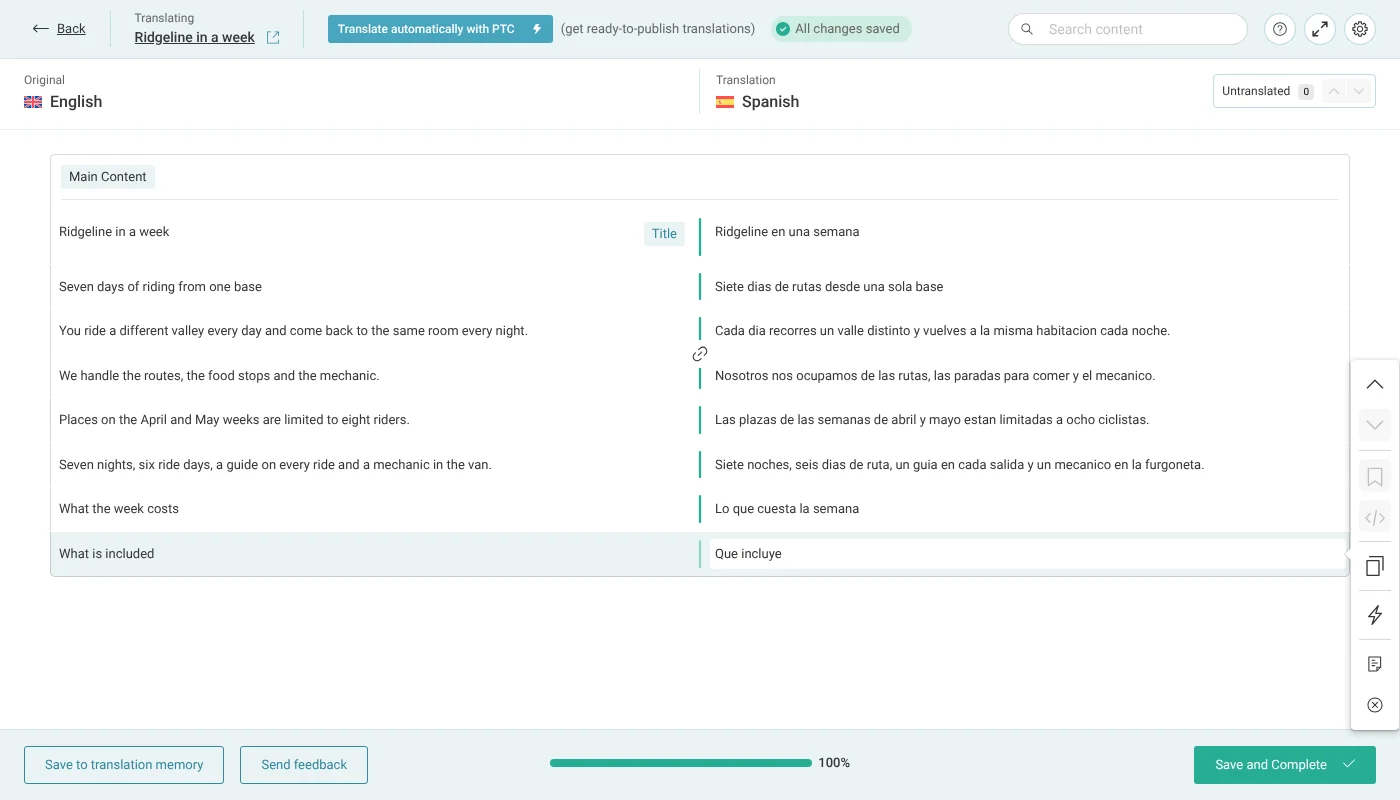
- You’ll be taken to WPML’s Advanced Translation Editor. If you have AI translation words, you’ll see your content automatically translated. You can review these translation and accept them, or click Undo translation to input your own. If you don’t have AI translation words, add the translations yourself.
- Click Save and Complete once you’re done with all your translations.
You should now be able to view your default language and secondary language pages on the front-end.
Page in default language
Page translated to Polish


All the Current Translatable WPBakery Page Builder Modules
WPML supports translating text in the WPBakery Page Builder modules:
- Text Block
- Separator with Text
- Message Box
- Hover Box
- Single Image
- Image Gallery
- Image Carousel
- Tabs
- Tour
- Accordion
- Pageable Container
- Custom Heading
- Button
- Call to Action
- Widgetised Sidebar
- Posts Slider
- Video Player
- Google Maps
- Flickr Widget
- Progress Bar
- Pie Chart
- Round Chart
- Line Chart
- Post Grid
- Media Grid
- Post Masonry Grid
- Masonry Media Grid
- Tweetmeme Button
- FAQ
- WP Search
- WP Meta
- WP Recent Comments
- WP Calendar
- WP Tag Cloud
- WP Text
- WP Recent Posts
- WP Categories
Translating Raw HTML Elements
One WPML setting decides if WPML sends the content of Raw HTML elements to translation. To find it:
- Go to the WPMLSettings page.
- Scroll to the Posts and Pages Synchronization section.
- Under Page builders options, find the Send to translation the content of raw HTML cells option.
This option is on by default. Keep it on if your pages use the Raw HTML, Raw JS, or Google Maps elements.
The option also decides what a translated page keeps when the Advanced Translation Editor (ATE) or automatic translation delivers a translation:
- Option on: The translated page keeps the Raw HTML, Raw JS, and Google Maps elements.
- Option off: WPBakery removes these elements from the translated page.
Buttons with a custom onclick action do not follow this rule. WPBakery removes these buttons from pages that ATE translates, even when the option is on.
When the option is on, translators see the code of your Raw HTML elements. Translators often do not understand code, and they can break it when they translate it. Tell your translators to change only the visible texts.
If an element’s texts do not appear in the translation editor, read more about registering page builder modules for translation.
Grids, Templates, Styles, and SEO Settings
Post and Media Grids
WPML translates the texts of the Post Grid, Media Grid, Post Masonry Grid, and Masonry Media Grid elements. On a translated page, the grid shows the posts in the same language.
On pages that you translate with the Translation Editor or ATE, the grid’s Load more button, pagination, lazy loading, and filters can show “Nothing found”.
From WPML 5.3, a grid on a translated page shows the translation of its Grid Builder item template. This is also true for visitors who are not logged in.
Templatera Templates
WPML does not support the Templatera add-on yet. When a page shows a Templatera template, all translations of that page show the template in the original language.
Custom CSS and Design Options
WPML copies the page’s custom CSS and the CSS of the elements’ design options from the original page to its translations:
- If you translate the page with the Translation Editor or ATE, WPML copies the CSS again each time you update the translation.
- If you edit the translation in WPBakery, the translation keeps its own CSS.
WPBakery SEO Settings
If you use the SEO settings of WPBakery, WPML sends their texts to translation together with the page. This includes the SEO title and description, the focus keyphrase, and the titles and descriptions for social media.
Using the WPBakery AI Translate Option
WPBakery AI can translate the text of an element in the WPBakery editor. If you use it on a translated page, you edit the translation in WPBakery and not in WPML’s translation editor.
WPML handles this translation like any other translation that you edit manually:
- When you open a translated page in WPBakery, WPML warns you that your edits will be lost.
- The next time you send the page for translation, WPML replaces the translation. Your edits in WPBakery are lost.
To keep a different translation in one language, read about using different translation editors for different pages.
Maintaining the WPBakery Page Builder Compatibility With WPML
We have prepared a developer’s documentation that explains how the WPBakery Page Builder works with WPML. Read more about updating the language configuration file to maintain the compatibility between WPML and WPBakery Page Builder.
Known Issues
WPML works fine with this plugin, but sometimes there could be minor issues we’re working on. This is expected as both plugins provide frequent updates.
Current unresolved issues:
You can also search all known issues including previously resolved issues for this plugin.
