

We make our living from WordPress, so once in a while we take our head out of the sand and look around. As part of a different research that I was doing, I stumbled upon a big warning light.
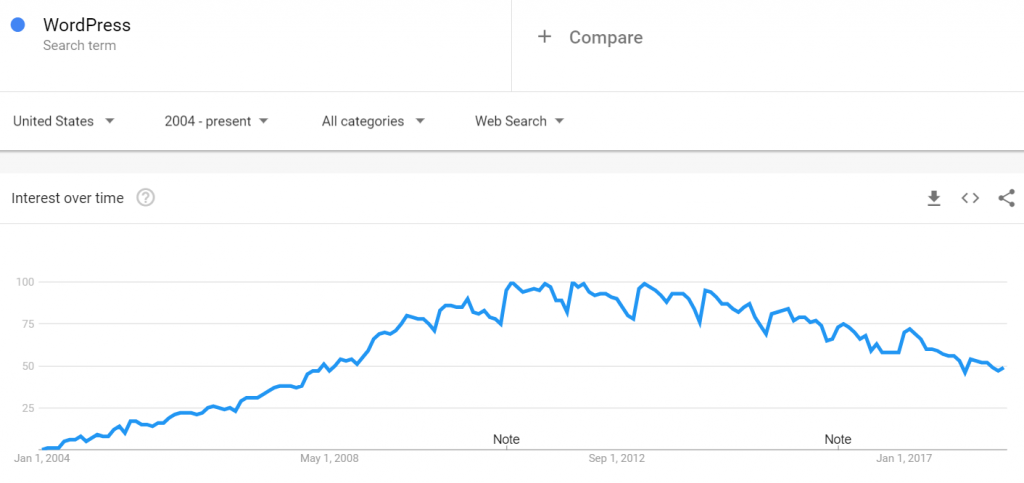
Try it, to see what I’m talking about:
https://www.google.com/search?q=business+website
https://www.google.com/search?q=restaurant+website
https://www.google.com/search?q=website+for+my+hotel
Even though WordPress powers 25% of the Web, WordPress is nowhere to be seen in any of these results.
Today, clients find WordPress because Web agencies use and recommend it. But when clients already come to agencies with another platform in mind, this can quickly change. It’s happened before to other ex popular platforms.
The only way to reverse this trend and put WordPress back again in the mind of prospects is by getting together.
We’re trying to do our bit by launching a new WordPress Marketing podcast.
Are you interested in helping? Please leave your comments with your thoughts.
Interested
The thing is, WordPress is becoming more of a specialised tool. This is practically by default, because today, no one (except very large, generally corporate buyers) wants to pay for design, or build involved with a WordPress site. The ‘no code’ site page builder tools for WP are nowhere near as slick as for things like Squarespace. Let’s be frank about this, WPML is brilliant, but my clients can’t work it. They need me, a specialist to operate and maintain it for them. This is not really to do with WPML itself, but the backend limitations – with respect to the marketing points made in the article, the WP Dashboard is a clumsy, unintuitive beast.
Back to marketing awareness, I did some work for a client who had (attempted) migrated from WP to Squarespace. It was only part way through that they realised the limitations. They’ll have to move back within the year. Squarespace promises far more than it can deliver, but it looks superficially sexy and easy, and answering all our prayers. WordPress is a dark beast in comparison!
That’s fine. I think that the owner of a tire company should be an expert in rubber and steel and not in websites. Business owners should typically get a “web developer” to build their sites. I want to make sure that they know that their site better run with WordPress. Then, they will seek a “WordPress developers” and we’re all set.
Amir, I completely agree with you. I am also owner of a company that is not in the business of building websites. When I look at doing something on WordPress I contact our developer team to do the majority of work and we handle the basic updates in house.
That said, Nathan’s comments are echoing my own. I think the shift is not only marketing putting WordPress on top. The main shift I see are with small to mid side entrepreneurs and creatives that are saving a fast buck by using alternatives to WordPress that they can easily build and manage themselves. I have seen it time and time again with my colleagues. I love WordPress but I am also the most critical of the platform I use to run my company.
They all want to make it free and by them selves and in the end they are running back to the dev’s of WP.
Just because the want something easy and free with building by theme selves they can ruin there own company respect, when a person is giing to visit a website and see it not professionaly done they will leave.
I don’t disagree. My point, perhaps not so clear above, is that what the client wants/needs, and what they can afford rarely allowed for a decent WordPress build, except for more specialised and high end sites.
Also, back to your analogy, that tyre company is probably not even interested in which technology here site is built with. They will ask about cost and ease of use. The WordPress backend its pretty unattractive compared with something like the Squarespace page builder tools.
With WordPress, an inexperienced person would have to research plugins, whereas Squarespace has (limited) functionality already provided without hassle.
These are relevant to educating and marketing WordPress to website clients.
And marketing ideas:
1) The WordPress name needs to be a ‘badge of respectability and reliability’. I think WP got a bad rep with so many non-standard customised (hacked, hashed together) sites in the early 2010s. I’ve come across some extremely shonky theme building especially, where a client has lost major functionality in the site from updating the WP version.
2) Perhaps more controversial, the name. As a WordPress designer/developer of nearly ten years, I’ve always thought the name WordPress a little eccentric. It feels positively antiquated now. The ‘pressing of words’ does not adequately, or even accurately, describe the product.
One should explain benefits of WordPress to a business owner in a way Paul Boag explained the process of owning a website in his “Website Owner Manual”. It has to address all the 40 components of business value fir B2B businesses.
I think the big disadvantage for open source here is that commercial platforms like Wix and SquareSpace can aggressively buy WordPress-related AdWords on social media, on YouTube, and for Google search results. Meanwhile there are no correspondingly deep pockets buying Wix or SquareSpace-related adwords steering folks to WordPress assets.
Last year pretty much every WP how-to video on YouTube started with an ad for one of those other platforms.
So unless we could put together some kind of serious trade association, then in terms of sheer face time WordPress will always be behind the advertising curve.
Meanwhile those other sites really are getting their acts together — not just getting the word out but also streamlining and simplifying authoring, updating functionality, boosting SEO capabilities, and boosting performance. Doing it in a way, I might add, that Automattic’s WordPress.com site definitely has not. And for better or worse, when people think “WordPress” most of them think “WordPress.com,” not WordPress.org.
I happen to think the Gutenberg initiative is a move in the right direction if we want to keep up. Not the current halfway page-builder part but the eventual full-on everything’s a block model that Morten Rand-Hendriksen has been doing such a good job of articulating.
My business has been focusing mostly on rebuilding and modernizing old HTML, Drupal, Joomla, SquareSpace, Wix, and (increasingly) older WordPress websites. For the last two years I’ve been doing this with the Beaver Builder page builder and theme exclusively. In the last month or two I’ve been approached to rebuild my own former client’s three, four, and five-year-old WP sites. And I’ve got to say that with a page builder it now takes a few days to rebuild sites that sometimes took months of hacking and tweaking with hooks, ACF, shortcodes or classed Divs in content, and hundreds and even thousands of lines of CSS.
The new crop of page builders work pretty well — easily comparable to the Wixes and SquareSpaces of the world. And while those old sites sometimes took days to train non-tech users, I can now routinely train them to edit their content, in about half an hour, usually over the phone, with no screen sharing!
If those older WP websites are how most people experience WordPress then the question isn’t so much why interest is falling off now — instead the question might be how WP ever got so much market share in the first place!
As I’ve said elsewhere, page builders are a giant callus that’s built up thanks to friction burns from the out-of-the-box WordPress experience. And thank goodness for the new generation of page builders (WordPress, Elementor, and others that don’t just bloat content areas with shortcodes.) Let’s hope Gutenberg catches up on core well enough to stop the bleeding. Or else let’s hope that hosting companies continue the trend of automatically adding decent page builders to their one-click WP installations.
—
One other point about the particular search results you’re finding. There are a number of companies out there that are offering targeted cloud-based sites for individual business types. Restaurants, hotels, law firms, medical practices, auto and boat dealers, and other “commodity” businesses may find those naturally attractive even though objectively the sites they get are more limited, not as performant, often way more expensive, and full of SEO-killing duplicate content.
I think one very good answer for this issue could be for more enterprising, local WP developers to start hitting the same trade shows and meetups these vertical site builders are sending their (typically paid!) hardball sales people to. Also to advertise in the same trade magazines and websites restaurant, hotel, and other business owners subscribe to. Also perhaps to do the same targeted bulk mail and other non-online marketing they’re doing too.
That’s WAY more than my two cents worth. But it’s an important issue. Thanks for bringing it up, Amir!
Thanks you very much for taking the time to share your experience. It helps very much.
This is a very important discussion. I just want to highlight a great idea that David Innes mentioned almost in passing:
“So unless we could put together some kind of serious trade association…”
A trade association of WordPress developers, plugin developers, web designers etc. could unite efforts and raise the funds necessary to do the sort of marketing (AdWords, etc.) that he and others mention. That’s how entrepreneurs, small businesses (and also big businesses) in other sectors address challenges they have in common.
Thanks for highlighting this comment. I agree. We need to have a pool of resources, which we can use towards our common goal. This is not something each of us can do ourselves.
Gutenberg actually makes it worse, it bloats content areas with html comments abused as markup for the blocks.
The search feature is useless due to this, see Gutenberg issue #3739, but they don’t care. Answer there is: Buy a service like Elasticsearch…
I’m interested, what can we do?
I’m interested
Count me in
Interesting, didnt know that, even tho I get too many wordpress projects for my clients.
As a developer I’m more interested in custom CMS platforms then wordpress, even tho wordpress is my main income. Will see what time will bring.
I agree with this post.
I have been building wordpress websites for over 8 years now, and I don’t remember a customer that came to me saying they knew WordPress.
Marketing team needs to find a way to improve its presence and I believe that investing on paid marketing such as keyword, retargeting and even email marketing are great ways to do so but a great way to be known without spending lots of money is through resellers and partners.
wordpress.com as a platform is functional, and its prices are arguably competitive but not many people knows about it.
Perhaps creating a reseller platform such as shopify, sharing it’s subcription with the reseller/partner and allowing partner signed sites to install a specific set of plugins and themes (such as WPML) in any tier (personal, premium or business) with a discount would serve as motivation for small agencies and freelancers to promote the usage of this platform.
Woocommerce is a simplified ecommerce system. Simplified because its customer and order management is not as complete as magento, opencart or even shopify, but I think what keeps it below all of the mentioned ecommerce platforms is the server overload and the security issues that comes along with a basic wordpress installation.
There are plugins that help make wordpress more secure but they are not being advertised and as there are many options, it takes someone with experience to know which one to use.
I leave this comment open to discussion and I welcome your opinions.
Cheers,
Abdiel
Thanks for your feedback. WordPress.com is a commercial entity. I’m thinking more towards what we can do as a community, to help WordPress.org become a better marketing machine for us.
I see,
In that case, creating content is the best road.
WordPress is positioned as a blogging platform and we all know it is far greater than that.
Maybe if we can gather enough people interested in creating blogs and commenting on blogs over the internet about wordpress versatility with real world examples and uses, people will see how powerful WordPress really is.
Yes. Creating content, placing it in the right place and promoting it. This is what I hope will come out of this discussion.
Would be great to take part of this. The best way to be popular is having an awesome product.
Let’s do it!
Here at ArenaBlue we totally rely on WordPress for our website, we really love it so yes, we are willing to help in any possible way!
Cris
I´m Interested
How can i help?
It’s my opinion that the best way to keep the platform gong is to continue to develop great tools and plugins. The reason why windows is so popular is because there is lots of software for it. The easier it is to develop great sites the more people will use it.
Yes, but marketing work is also necessary. “If you build it, they will come” doesn’t work.
Why not, lets do it.
Yes, please!
I am seeing a big push by expensive developers wanting to create custom websites “bespoke” in the UK charging vast amounts of money to produce sites that could easily be done with WordPress for a fraction of the cost. But of course these firms make a lot more money and they have clients who are in effect locked in.
Drives me nuts and as an IT Manager I actually find myself having to waste time telling other managers why they don’t need to waste buckets of money.
I run the most popular WP website in Italy called SOS WP. I know some of you guys personally and I can say that what you’re stating is true, and I am interested in getting together and working out some strategy (at least in my Italian market).
I think hosting companies like SiteGround, Bluehost etc should be greatly involved in this effort and I am sure they would gladly pitch into this effort as well.
Thanks for your support Andrea. I’ll keep you updated on our thoughts and plans.
Another enormous factor that is surely impacting current day trends is the fact that WordPress was designed in an era where “websites” on big screens dominated, not mobile devices. I think there needs to be a substantial shift in thinking more or less. I can tell you that in China, for example, the “web” for an entire generation of young users IS mobile apps and probably for a solid half (including business) of the population, WeChat.
To demonstrate the paradigm shift in thinking, consider the concept of the “login”. On the web this largely involves *typing* the username/e-mail (usually ASCII chars) and password (twice) + some captcha or 2FA for security. Not the case in many places I’ve been to where mobile dominates. The login AND links now involve scanning QR codes, entering a phone number once (digits which are near universal and unique enough) for identity verification, validate # via SMS, then fingerprint/faceid + (pin/2FA if there is need for more security). Can this be done with a myriad of plugins, frameworks, libraries, flex boxes, hooks adjusting WordPress? Possibly, but it would be severly overweight and wouldn’t be a very good, lean user experience.
The downtrend may not necessarily be a marketing issue, it may have more to do with people using the right tool for the job. May need to consider whether WordPress in its current state is really that right tool going forward?
WP isn’t perfect. No tool is perfect. Even Microsoft with all their resources need to release bugfix and security updates. We’re all development-oriented and I feel that our ecosystem is falling behind our competitors in marketing.
interested
I have struggled with some customers about the security of WordPress. They often hear from other people who dont know anything about it or read alarming articles about this online. I always tell them that it is unfair to categorize WordPress like that, being that almost 30% of websites are built on the plataform, so by just looking at those numbers, of course hackers will look this way but there is also a lot you can do to prevent it. No website is 100% safe from being infected with virus. We have to keep educating our clients!
That’s all true, but still most business owners have no idea about different website platforms. I think that we need more marketing for WordPress for end-users. Everyone knows Coca Cola and they still bother advertising. There’s a reason.
I was one of those that struggled with security. There are a lot of plugins that will help but it would be great to have that security built as standard. Again back to ease of use…
Matt
I too have been somewhat concerned about the stagnant state of WP as a platform, but search result trends don’t necessarily mean too much. The graph simply shows that from 2004-2008 people were trying to learn more about what WordPress was. Now that it has critical mass, there’s not as much need for people to try and understand it and thus fewer searches for that solo keyword.
Having said that, we do need to be alert to other platforms like Square Space and Wix, but my personal feeling is that any brand that tries to “own” a proprietary server platform will ultimately fail to gain the kind of traction enjoyed by WP. The world has gone beyond that old business model and it won’t easily go back there. On top of that is a growing weariness of subscription models.
Of course, there will be continued pressure from these platforms and people will be drawn to them for various reasons. Most important is the need to keep things simple. As demands on time and DIY solutions increase, we need to ensure that WP and its plugins become ever easier to use. The things that make WP so amazing, such as the huge community of supporting vendors like WPML, are also one of the challenges of the platform. These third party products can be confusing for non-technical people, and sometimes even for experienced developers like myself.
By the way, comments are not showing up. And when I click your reply back link in email it takes me to a strange page with just a few comments and no way to read all. Not good WordPress marketing at all! 😛
We enable pagination for comments. There’s a link to “older comments” at the bottom of the comments list. Right now, we’re at the middle of page 2. I think (and hope) that we’ll have several pages of comments to this post.
I see them now!
I’ve been building with WordPress for about 10 years for businesses of all different types. In general most don’t really care what’s its built on, they just want it to look good and be easy to add edit etc. Which is why Squarespace etc use that in their campaigns. Now I’m going down the plugin route, though we do have marketing campaigns targeting WordPress developers, most of our focus is on targeting the businesses that will be the end users of our product. We have also found that it is the businesses that have the most engagement with our questionnaires etc.
I’m also interested. Thanks KS for bring this topic to the attention of the community.
I think the point is most of the SMEs are thinking the internet is FREE. They are not willing to put more money on the investigation of internet business.
While we can see the trend that they are turning to the very CHEAP platform (e.g. WIXX) It may be found by themselves, or even worst that some “developer” cheats to their client to use those platform to build a “website” with some online tools like MXWord.
I can’t say WP is the greatest one for web building, but it is a mature tool for sure. And in fact the WP is FREE. The reason why the SMEs/”developer” not using it because they haven’t got enough knowledge to judge, or had been cheated with WP before. (I’ve seen some website build by some “developer” is really suck.)
I’d like to know how to build up the confidence of clients to use WP, and quality developers/agencies. If you have any answer to that, I’d loved to listen.
Thanks.