

We make our living from WordPress, so once in a while we take our head out of the sand and look around. As part of a different research that I was doing, I stumbled upon a big warning light.
Try it, to see what I’m talking about:
https://www.google.com/search?q=business+website
https://www.google.com/search?q=restaurant+website
https://www.google.com/search?q=website+for+my+hotel
Even though WordPress powers 25% of the Web, WordPress is nowhere to be seen in any of these results.
Today, clients find WordPress because Web agencies use and recommend it. But when clients already come to agencies with another platform in mind, this can quickly change. It’s happened before to other ex popular platforms.
The only way to reverse this trend and put WordPress back again in the mind of prospects is by getting together.
We’re trying to do our bit by launching a new WordPress Marketing podcast.
Are you interested in helping? Please leave your comments with your thoughts.
Group,
I am not too worried. When prospects are interested in Wix or Squarespace, I take the time to explain to them that the difference between these solutions and a self hosted site powered by WordPress is the same as between renting a flat or owning a house. They trust me most of the time. Otherwise, I wish them good luck.
What worries me more, is the popularity of WP, which makes it a target of choice for script kiddies and other ill intended people. So much so that I now have to sell maintenance packages.
WooCommerce also worries me. It was my go-to shopping cart. They now release updates without thinking about theme compatibility legacy.
So, besides client education, security and e-commerce issues, what do you propose? I don’t think we should wait for WP.org if their revenues come from WP.com. Maybe it falls into our hands, freelancers and SMBs, to blog away that a self hosted WP powered websites has the best long term ROI.
WordPress is so common that web developers use it “by default”. When customers come to a web agency, in most cases, they don’t have any “name” in their mind. And they don’t care what the agency use to get their website done. So, WordPress is kind of internal term between us.
End-users -> end-product. WordPress is somewhere in the middle.
Count me in.
I’ve been using WordPress core with various theme flavors and wysiwyg overlays for 7+ years. Many micro / small businesses try Wix, Squarespace and other Builder tools; then ask other businesses and friends what they have used. Thankfully that is when WordPress is mentioned.
The sticking point is often pricing; because Wix and others have set their pricing so low it creates an uphill battle explaining why having a website created from scratch is so much more.
Whatever you come up with will need to have some sort of show-reel video demo highlighting all the “sexy” bits of WordPress.org and having a more bespoke solution provided by professionals; who are also likely to provide other online advice too.
Automattic should be expected to help too; they have plenty at stake now owning WooCommerce too. TV advertising in Australia now showing Wix and other larger DIY website builders. That bar is too high for me 😀
Yup. I hope that the big players will be willing to be involved. It’s very important to do this for the good of the platform, without having hidden/private agendas to promote. Otherwise, it’s not going to work.
Hi Amir
it’s great that someone tries to shake up a bit the WordPress Verse.
While WordPress could be used in many scenarios, I easy can come up with a few reasons why I personally in many scenarios can’t recommend WordPress and suggest other solutions.
If WordPress right now would be a newcomer on the internet, it would not be able to gain any traction compared to the competition at all.
That WordPress was getting so wide spread, could be rather called a lucky strike, providing a platform for people that love to write and publish a few pics without having a tech background.
And this mindset is still very present in the WP Community – which is not negative, but also not very progressive either.
But if I would start today and just want a nice looking, flexible CMS driven website with the option to have a blog and a small shop, there are many hosted solutions that are a better choice which require less skills and knowledge. And are less time consuming.
From the visual aspects of a WP site just the numbers of the installed page builders show a clear picture that the time of static themes is not what users want.
Why WordPress never came up with a s solid design option (hints to Toolset Layout ) which then could be “skinned” to fine tune the look.
Then WordPress boosts over 50’000 plugins which easy can be sorted into a few categories like:
– experimental,
– try at your own risk,
– look at if you want to learn how to write plugins,
– things that are missing in core
– apps with either too much- or missing features for your purposes
– some really useful tools
Just to break it down – with WP and the right tools, one could hypothetically build about 90-95 percent of existing websites using a CMS, before the need of programming a custom solution from scratch.
But about 75-85% of those sites could probably be built easier, faster and more reliable with alternative solutions.
This leaves maybe 20% of CMS driven Websites, where WP is the adequate platform, but only due to the availability of third party components.
I mean what would WP be if you want to make a multi lingual site, a custom real estate site or a custom classified site or directory or even worst all of those different site types combined … the list could go on.
A lot of this can be done with WP – by either coding them from scratch or use tools like WPML, a decent Page Builder and Toolset. And drive them to their limits.
But if one has the coding skills and resources to make it all from scratch – why should they use WP at all?
There could be a lot more said about the pros and cons of WP and I remember that you recently asked the question at the Toolset blog which features should be added that are valuable for the customers.
This is the question WP should start and carefully evaluate the responses and act accordingly while they still can.
But it’s still not an excuse for not marketing our platform, right?
Good point Amir 🙂
Marketing can definitely help a bit, but do you remember OS/2 with its 100 Million US$ campaign?
If spending half of that money in UI, UX, drivers development and listen/deliver to what customers want and need, it might be still around today 🙂
Back to the start of your topic which lets me assume its focused on location based small businesses, restaurants and smaller hotels.
Those clients rarely come up with a platform in mind but they want a website to represent their business and attract customers, social media linking, publishing news and sell some products and so on.
And they don’t care much which platform is used, as long as it delivers what they need at a good value for money ratio and is easy to handle.
The only USP in pro for WP for this customer segment that comes to my mind at the moment is imho that WP has a market share of a bit over 30%
But there are other segments with the need of multi language support, community features, bookings, classifieds, dynamic data, charts, security and legal requirements and more in which WP will be a nice low cost choice if the adequate plugins are available and deliver those features.
I guess this segments could be nicely addressed with the use of WP, some plugins and your tools (WPML/Toolset combo) even if there are a few things on my wish list for features Toolset should have. 🙂
The Google searches that I included in my post are just examples. I’m not suggesting to focus all marketing efforts on restaurant sites. I showed a few examples, where WordPress could have easily appeared if we did the right marketing.
Good marketing doesn’t need to cost 100 million. I’m sure that as a business owner you do your own marketing at a much more modest budget. Without doing your own marketing, would you have a business? We wouldn’t.
I am in to help, I am an ECM specialist/Developer
i am going to mention the obvious even tho it is clear i think. If we strategically plan this , we can definitely push for better marketing.
if we can highlight the strength of WordPress but not in terms of its simplicity but rather for what it can do better than its competition then we can definitely alter the public’s perspective about it. I did work with other platforms such as wix, these platforms do win in marketing but god they suck at soo many things such as plugin licensing, the limitation of the platform and more.
Interested.
We are struggling on a daily basis with tech choices and advising our clients on the best solution in their situations. We use Magento, Shopware, WordPress/Woocommerce.. and are flirting with Shopify and Lightspeed. My personal preference is to bring this back to 3 (Shopware, WordPress/Woocommerce and Lightspeed), but we are in shaky times – so no final decision has been made yet.
In our home market (The Netherlands and Belgium), most people know WordPress (.org), but hear that it is difficult (expensive) to maintain and there are security problems. From a marketing perspective, this would be my top priority to tackle.
The great thing of Shopify- or Lightspeed-like solutions is that people don’t run in problems, there’s an easy builder and it looks naturally good. HOWEVER, many limitations are there. especially when it is about running a MULTILANGUAGE webshop. (You must like that..)
I am happy to team up and see what we can do. Feel free to drop me a line. I believe we (as a community) are much stronger than a few marketing bucks from Wix.
Cheers,
Stefan
Hi there!
I’m interested.
Thank you
Well — my company develops and provides managed hosting of WordPress websites. I am actually in the midst of writing the section — ‘why WordPress’ — it is the sheer number of plugins that cost effectively allows businesses to perform online.
The sites can be bilingual — sell products and take online payments — allow uploading of files — private areas — book rooms and take payments —- book appointments —interface with social media —- have chatbots —– just about every need a business has is met by WP.
The backend means we can do just about anything with the data collected — parse to other systems — including online tools like Trello and upload to Google Drive.
Sure it has its issues — hence the managed hosting — we maintain it — as all CMS needs maintenance — security is addressed —- but daily backups to recover from.
Totally here to rock on WP!
Interested
Interested
This is an interesting topic. I haven’t gone through everyone’s comment yet, I just want to quickly throw in my two-cents-worth.
Inspired by the conversation with a new client, his impression of WordPress is:
“Often needs update”
“Easily targeted by hackers if not updated often enough”
“Updating software often broke the site”
“WordPress is losing popularity”
Based on above we can see the problem is clearly not with WordPress, but many people who went around claiming they know how to build WordPress websites but failed to follow best practices (such as, use a CHILD THEME and DO NOT OVERWRITE PLUGIN CODES!)
There is no shortage of free tutorials and cheap courses teaching people how to use WordPress correctly; but what to do? There will always be people who just do what they do.
(Sorry if I offended anyone here, but really, if you feel offended then this is something for you to think about.)
I used to market myself without making a big deal about what CMS I was using, because I was afraid I would be limiting my reach and my potential market. I have since adjusted my position — I now market myself very specifically as building WordPress websites and have integrated it into all of my website’s content, marketing materials, etc. I think the surest way to make WordPress most prominent is for all of us to embrace it and market ourselves this way.
Coincidentally, I’ve gotten more traffic and more clients since changing my strategy. It was a good move.
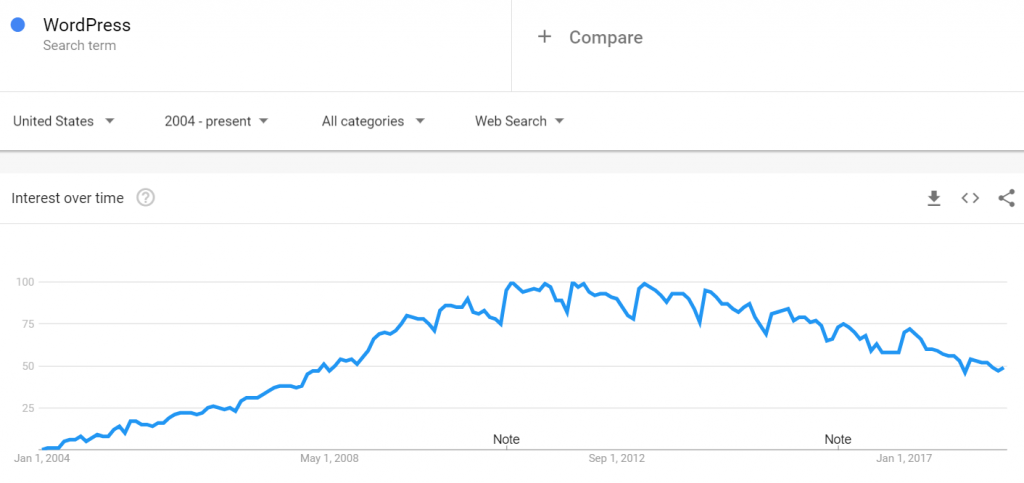
WordPress once a time was the go to place for small business owners (which they are many) for creating a website by themselves. Then other tools appeared to satisfy that market, like wix/squarespace , and wordpress COMPLETLY losted the market share for small business owners who want to have control and make a website almost for nothing. You can see in that in the google trend.
So that battle is losted, completly, now WordPress is the go to place for front end developers, agencys, etc. And there is also competition, but the clear leader is WordPress because of its ecosystem which is and will be unbeatable for ever.
So, speking honestly, wordress wont be better than it is now, certain companies like wix/squarespace will always win because de ease of use for non tech people.
So anyways, i propose this strategy:
Market WordPress as the number one in SPEED and SEO, you want to make WordPress cool again? let us, the WordPress community use our Strenght and lets write millions and millions of blog posts, youtube videos and lots of content marketing WordPress as the best solution for seo and speed, we need cheap really fast hosting companies, we need really easy and good seo plugins, we need to use all the power of Multisites. And also we need to use Woocommerce as a tool for this. So customers will ask for wordpress, and then, we will profit, design tools, themes, agencys, etc. THATS HOW YOU MAKE PEOPLE TO WANT WORDPRESS===> SEO AND SPEED.
We are interested.
– Modern Tribe / The Events Calendar
Thanks Zachary. You have a big voice and I’m sure that we can do much together.
When prospects are interested in Wix, Squarespace, or Shopify, I take the time to explain to them that the difference between these solutions and a self hosted site powered by WordPress is the same as between renting a flat or owning a house on a piece of land. They trust me most of the time. Or I wish them good luck.
What worries me more, is WooCommerce. It was my go-to shopping cart. They now release updates without thinking about theme compatibility legacy. Not even Woo child themes. Without a solid e-commerce solution, WP is doomed. Any lead?
I believe client education is key. What else? I don’t think we should wait for WP.org if their revenues come from WP.com. So it falls into our hands, freelancers and agencies, to blog away and preach that a self hosted WP powered website has the best long term ROI.
I say, let us all write a post about the WP ROI. Save as draft. Share the permalinks. Integrate them to our post. Choose a time and date. All publish at the same time.
What say you?
I’m interested
When prospects are interested in Wix, Squarespace, or Shopify, I take the time to explain to them that the difference between these solutions and a self hosted site powered by WordPress is the same as between renting a flat or owning a house. They trust me most of the time. Or I wish them good luck.
What worries me more, is WooCommerce. It was my go-to shopping cart. They now release updates without thinking about theme compatibility legacy. Not even Woo child themes. Without a solid e-commerce solution, WP is doomed. Any lead?
I believe client education is key. I don’t think we should wait for WP.org if their revenues come from WP.com. So it falls into our hands, freelancers and agencies, to blog away and preach that a self hosted WP powered website has the best long term ROI.
I say, let us all write a post about the WP ROI. Save as draft. Share the permalinks. Integrate them to our post. Choose a time and date. Publish at the same time.
What say you?
Stuff happens. Strong developers like the WooCommerce team don’t try to make this kind of mistakes on purpose. They’ve been in this for a while and they know how painful breaking changes are.
My working assumption is that we’re all doing our very best to make things work. I can testify that this is our state-of-mind in WPML and Toolset development.
What worries me is that our overall marketing for WordPress is far behind the marketing done by our competitors. It’s starting to show the result.
I’m interested in this.
Nowadays WordPress is being replaced for other site-specific, easier to use, tools. Hence the market share for WordPress is decreasing.
Not so long ago, WordPress was the way-to-go to publish your corporate site, your shop (WooCommerce), your blog, your magazine, even forums with bbPress and so on.
Today the world has changed, and people are moving forward to mobile computing using smartphones and tablets, and its support on the WordPress admin panel isn’t as good as it could be.
Even, WordPress is becoming complicated and users aren’t going to learn things if they don’t need it. They prefer already made solutions like Shopify, 1&1 my web, SiteBuilder and Facebook pages. We all know they’re constrained in contrast with WordPress, and they cannot get very professional results, but that’s not the point. The point is the user experience, even if results are worse.
I found myself trying to migrate users from such static page generators to WordPress and getting complains about how hard is to use ‘pages’, ‘blogs’… and if we start talking about custom post types, all answers were “NO”. Except those who were willing to pay me/us to manage its things/content/whatever.
So my customers have ended on “I’ll pay you for the hosting… if you move my contents from my current free tool for free, and if you manage it for free, and if you …. for free’. If its WordPress or whatever for them doesn’t matter; WordPress is something we only know on the professional market as de underlying CMS of (most) sites. End users don’t complain about that, and they’re happy without knowing that.
And if they wanted ‘cool’ designs which costs money, and more money to personalize it for them, we are in the same “NO” situation. Same things apply to plug-ins and subscription recurring plug-ins. The other tools are entirely free despite of results, and getting professional for small sites became somewhat expensive for most users.
interested
I design in WP and just did 2 installs back to back with WPML. I do like the WP platform but it can be bulky depending on the size of the site and capabilities built on the backend. One of the biggest advantages to WP is the ability to integrate 3rd party CC processing APIs. Wix and square space fails on this end for clients in the ‘high risk’ categories at the banks. I could not count the # of clients who left wix/square just for this reason alone. Shopify charges 2% on all transactions if you use a 3rd party API for cc integration. That 2% is enough for a lot of larger clients to leave the shopify platform looking for another solution. As they say, shopify is like renting a car and WP is like buying the car. 🙂
We are a software company, and we experienced with many platforms including wordpress, eventually wordpress will be replaced with some better alternatives. unfortunately wordpress has serious problems, in a developer view it is very old and lots of today software development tools and practices won’t apply to it , as a web site admin it is very old , wordpress admin panel is for stone age , we are living in the age of angular, vue and react , many cms or ecommerce platforms are now supporting such technologies for admin user interface, but wordpress still using jquery 1.x for the sack of never updating plugins or backward compatiblity. with respect to efforts of wpml team almost all of our customers cannot make sense of multi language admin panel of wordpress, for example check prestashop they are now using vuejs for admin panel and user experience changed a lot.
experienced developers are suffering from wodpress architecture , this is a fact.
wordpress fell behind in many areas and we cannot see any real change in the core, so m friend it will happen, i suggest you consider of other platforms.
Hey everyone, Amir thank you for the interesting input
When we were beginning with WordPress, it was about finding the template, that would fit our specific needs as it was design-wise. Out of the box. Plugins were few. And the price for production was low.
Six years after that, the price for clients multiplied several times. Why? Because the templates we are using are focused to provide as much customisation as possible through well-designed elements, CSS we learnt along the route and plugin knowhow we developed through these years, including paid versions. Plus, we’re still dependent as an agency on the quality support, which is the second most important factor, because we’re no coders and we’re learning big time with ever new project. After all these years of practice.
Together with this, we’ve always been focusing the simplicity of CMS for the clients for them to be as independent on us as possible and for us to stay operative, instead of being locked as content managers of our clients. We’ve been producing information for our clients how to manage the thing.
As far as it’s about using what’s already built in the system, they’re relatively fine. As far as they’re used to working with some CMS, of which WP stays the most comfortable one compared to desired output, I believe. Seen about six different platforms, that gradually became unusable just because of the technology’s development pace, which they could not keep up with.
Result? Clients still don’t even update. Why? The UX with the system is way too complicated and even updates may bet their website down, I think. Too distant from their top priorities and real-world operations knowledge. Yes, we feel it and agree with the point you made. We became specialists in the field we initially thought everyone could learn. Clients, if working with the CMS at all, stay within Pages, Posts, sometimes Portfolios and Sliders (using Revolution with Avada). String translation? Sorry, forget it… 🙂
Looking forward to more discussion!
Matoosh
There are 2 type of clients who come to you with a platform in mind:
1. Client who heard it from a friend / colleague in general.
2. Client who did research / comparison on their own.
Clients from #1 have heard of the good (maybe bad) things of said platforms. But come to you for professional advice on whether it is the right platform for them. This doesn’t mean they won’t use WordPress. Rather, your professional view of how it compares and what are the advantages / disadvantages to them.
Clients from #2 have the facts. However, facts could be outdated. Again, it comes down to us giving them professional advice.
At the end of the day, we need to be aware of new / existing platforms in the market and recommend the ideal solution which fits the client’s requirements.
For me, if the client is adamant on working with X platform and I don’t do it – I’d recommend them someone else who’d deliver the same quality of service as I do. Or, inform them outright it’s not something within my scope and that they’ve to ask someone else to do it.
I do not believe in hard-selling. I believe in valued client-vendor relationships more.
Interested