
In order to run, WPML requires the following:
- WordPress 4.7 or later
- PHP 7.0 or above with memory limit of at least 128MB while 256MB is recommended (see how to increase WP memory). Keep in mind that the required memory for your site depends on your content, theme, and all plugins.
- MySQL 5.6 or above. Alternatively, you can use MariaDB 10.1 or greater.
- That you can create tables in your database.
- WordPress REST API must be enabled for WPML to function properly.
- Multibyte String extension for using WPML String Translation.
- SimpleXML extension for using XLIFF files in WPML.
- The eval() PHP function must be enabled. More about this in the section about eval().
- The libxml PHP Module 2.7.8 or higher.
How to check which version of PHP you’re using
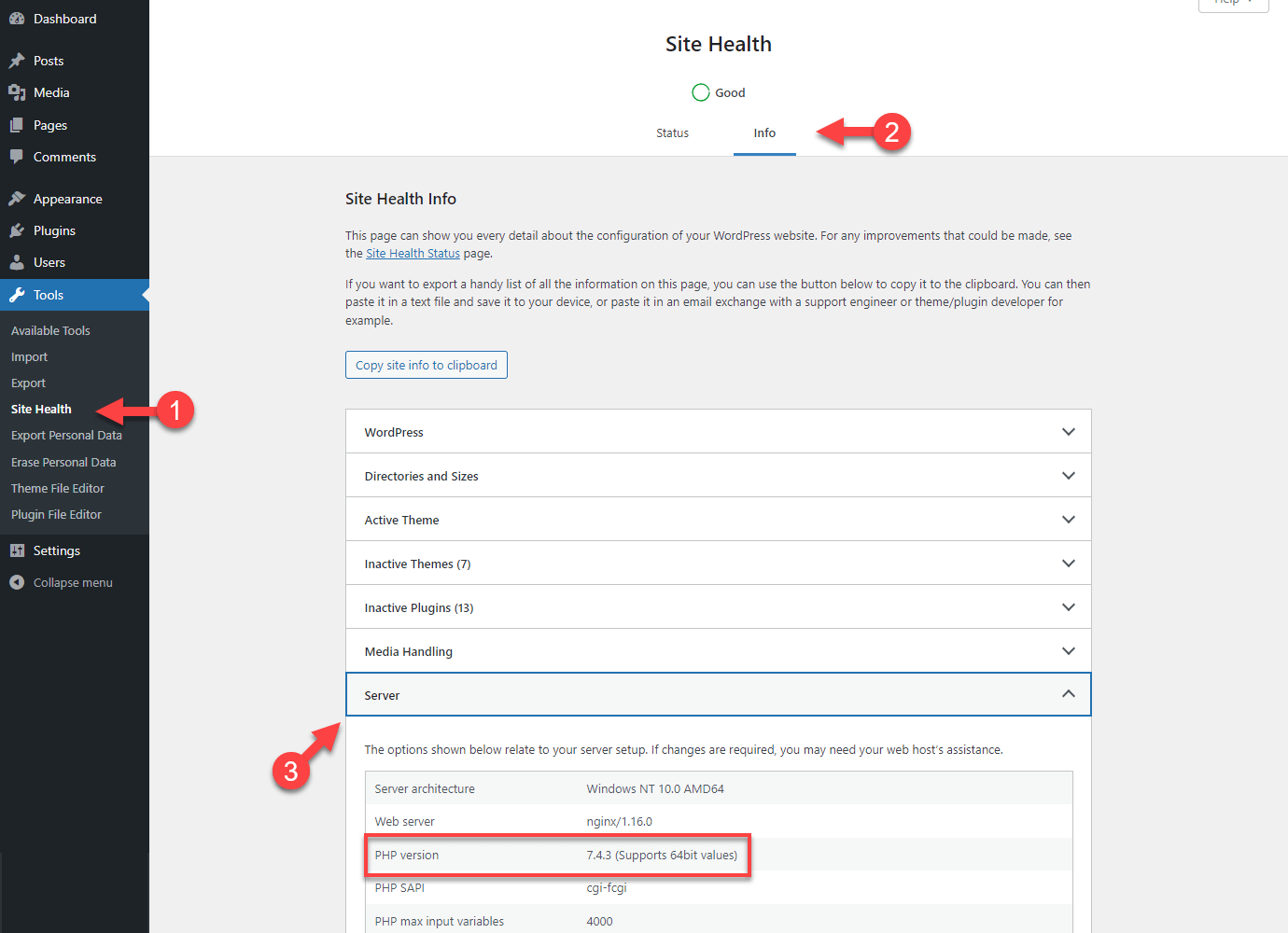
To check your server’s PHP version, log into your WordPress admin, go to Tools → Site Health and click the Info tab. There, you will find your PHP version under the Server section.
Permalink structure
WPML adds language information to URLs. It has been tested with the following permalink structures:
- The default
- /%year%/%monthnum%/%postname%/
Explanation:
Other permalink structures may work too but can cause problems on different configurations. In all our sites, we are using /%year%/%monthnum%/%postname%/.
For pages, you will get the exact same URLs as with /%postname%/. However, with this permalink structure, there is no way WordPress will confuse between pages and posts, triggering potential problems for language resolution.
Usage of the eval() function
The eval() function must be enabled because WPML uses TWIG framework for its structure and templates, which makes WPML dependable on this function.
Most popular templating engines, such as Smarty and TWIG, have found that it is faster to write the PHP code to a file. In that way, it can take advantage of the OPcode caching and avoid to require a run-time building of template code.
TWIG runs a lot of checks and sanitation to avoid possible attacks and it is safe to be used with WPML. However, we cannot assure that other developers have made the same checks we did in our Quality Assurance process.
We are still investigating possible solutions which do not require compiling templates on the fly and would make the use of the eval() function unnecessary. However, at the moment, this is the best solution.
Please note that usually, the eval() function cannot be disabled in PHP, but some extensions such as Suhosin can do that. These extensions might be installed and configured by your hosting provider.