Problem: The client is running a multilingual site with 5 languages and is using Elementor Pro's saved templates to customize the product page and product category templates. They are using
add_action
to add the saved templates to the product page or product category page. However, they have encountered an issue where the
add_action
does not fire for the German language (de), while it works fine for other languages.
Solution: If you're experiencing a similar issue where
add_action
is not firing for a specific language on your multilingual site, we recommend you try the following steps: 1. Ensure you have a full backup of your website and database. 2. Upgrade WordPress to the latest version. 3. Check your WPML version and upgrade to the latest if necessary. 4. Deactivate all plugins except WPML and its addons to check if the issue persists. 5. Reactivate each plugin one by one, checking the issue after each activation to identify any conflicts. 6. If the problem continues, repeat the steps with a default WordPress theme, as your current theme may not be compatible with WPML.
Additionally, WPML provides filters and action hooks for multilingual support. You can find more information in the following resources:
Please note that the solution provided might be irrelevant due to being outdated or not applicable to your case. If the issue persists, we highly recommend checking related known issues at https://wpml.org/known-issues/, verifying the version of the permanent fix, and confirming that you have installed the latest versions of themes and plugins. If you still need assistance, please do not hesitate to open a new support ticket with us.
Problem: The client updated to the latest version of the WPML plugin and is seeking assistance with plugins that are not on the WPML compatibility list.
Solution: We recommend contacting the authors of the plugins in question and requesting a compatibility update. We provide useful information for developers to make their themes/plugins compatible with WPML. Please see the following documentation:
Please note that the solution provided might be outdated or not applicable to your case. If so, we highly recommend checking the related known issues, verifying the version of the permanent fix, and confirming that you have installed the latest versions of themes and plugins. If the issue persists, please open a new support ticket with us.
Problem: The client was unable to manually translate pages and was concerned that it might be due to not having paid for translation credits. They wanted to manually translate without using auto-translation services and were experiencing issues where translated pages appeared broken or did not display correctly.
Solution: 1. We confirmed that manual translation is possible without the use of credits by setting the Translation Mode to 'Translate What You Choose' under WPML > Settings. 2. We instructed the client to go to WPML > Translation Management, select the page they wish to translate, assign it to a translator, and then manually translate the content. 3. We provided links to relevant documentation:
4. We addressed the specific issue with the /contact page by re-translating and publishing the page in French and Spanish, which resolved the display issues on the frontend.
Please note that the solution provided might be irrelevant due to being outdated or not applicable to your case. If you're still facing issues, we highly recommend checking the related known issues, verifying the version of the permanent fix, and confirming that you have installed the latest versions of themes and plugins. If the problem persists, please open a new support ticket with us.
Problem: The client was experiencing a 404 error on the Arabic version of their website when Object Cache Pro was enabled. Clearing the cache temporarily fixed the issue, but it would reappear.
Solution: First, we recommended checking for any manual redirection rules set within plugins or code and deleting them. Then, we advised the client to: 1. Navigate to the root directory of the site using the File Manager in the hosting control panel. 2. Locate the '.htaccess' file and open it in an editor. 3. Backup the contents of the '.htaccess' file by saving it on the computer. 4. Replace the '.htaccess' rules with the default WordPress rules found here: https://wordpress.org/documentation/article/htaccess/#basic-wp 5. Save the changes and clear the caches from the site, browser, and server. 6. Try to access the Arabic version of the homepage. If the issue persisted, we suggested going to 'Settings > Permalinks' in the WordPress Dashboard and saving the permalink structure without making any changes.
If the solution provided is not relevant due to being outdated or not applicable to your case, we highly recommend checking related known issues at https://wpml.org/known-issues/, verifying the version of the permanent fix, and confirming that you have installed the latest versions of themes and plugins. If the issue persists, please open a new support ticket with us for further assistance.
Problem:
After updating original post, translation automatically publishes too.
Solution:
We couldn't reproduce the problem. However, there seem to be a temporary issue with client's setup and upon retrying they couldn't reproduce either.
Problem: The client needed assistance in identifying the correct Custom Field description to manage translations in the WPML > Settings > Custom Fields Translation area. Solution: 1. We recommend setting the custom field preference to "Copy Once" in WPML > Settings > Custom Fields Translation, then manually translating the post and HTML code using the WordPress editor. 2. To find the field ID: - If the client created the field, it is the field ID. - If it is part of a theme or plugin, the client should contact the support of the respective theme or plugin to obtain the field ID. - Alternatively, the client can use the browser's Inspect tool to locate the field ID through the HTML elements.
For further guidance, please refer to our documentation:
Please note that this solution might be irrelevant if it's outdated or not applicable to your case. If the issue persists, we highly recommend checking related known issues at https://wpml.org/known-issues/, verifying the version of the permanent fix, and confirming that you have installed the latest versions of themes and plugins. If needed, do not hesitate to open a new support ticket with us for further assistance.
Problem: The client is unable to find the texts of the 'DIVI form helper' plugin in the advanced translation editor, specifically needing to translate the module fields 'Confirmation Email Subject' and 'Confirmation Email Message'.
Solution: 1. Navigate to WPML > Settings > Custom XML Configuration tab. 2. Add the following XML code and save it:
3. Make a minor change and update the page. 4. Update the translation.
The fields should now be available in the translation editor.
Please note that this solution might be irrelevant if it's outdated or not applicable to your case. If the issue persists, we highly recommend checking related known issues, verifying the version of the permanent fix, and confirming that you have installed the latest versions of themes and plugins. If you still need assistance, please open a new support ticket.
Problem: The client is experiencing an issue where attempting to switch the administration language from Greek to English in the WordPress backend redirects them to the frontend without admin access. Despite following the instructions provided by WPML, the issue persists, and attempts to resolve it through cPanel result in the need to restore from a backup. Solution: We recommend disabling all WPML plugins to determine if the problem is related to WPML or another cause. If the issue persists after disabling WPML plugins, it suggests that the problem lies elsewhere. In such a case, we advise the client to check for conflicts with other plugins or the theme.
Please note that the solution provided might be outdated or not applicable to your specific case. If the issue remains unresolved, we encourage you to open a new support ticket. We also highly recommend checking the related known issues, verifying the version of the permanent fix, and confirming that you have installed the latest versions of themes and plugins. If further assistance is needed, please contact us through the WPML support forum.
Problem: The client has a taxonomy called "Technologies" on their website and is using the free Yoast SEO plugin to generate a sitemap. The sitemap displays pages in English but is missing the translated German taxonomy pages, even though taxonomies are open for indexing. Solution: We explained that different sitemaps for each language are only available when using the "different domain per language" option, as detailed in our documentation: Using WordPress SEO with WPML. Since the client is not using this option, WPML automatically adds "hreflang" tags to each page, which means separate sitemap links for each language are not necessary. Therefore, the translated taxonomy links do not appear in the sitemap file.
Please note that this solution might be irrelevant if it's outdated or not applicable to your case. If the issue persists, we highly recommend checking related known issues at WPML Known Issues, verifying the version of the permanent fix, and confirming that you have installed the latest versions of themes and plugins. If you still need assistance, please open a new support ticket with us.
Problem: The client is experiencing an 'Access Denied' error when trying to edit posts with WPML activated. The issue occurs on all posts, pages, and custom post types.
Solution: We recommend checking if the client is using WP File Manager version 7.2.3. This version has been known to cause similar issues, which have been resolved in version 7.2.4. The client should update WP File Manager to the latest version to fix the 'Access Denied' error. For more information, please refer to the WordPress support forum: https://wordpress.org/support/topic/access-denied-99/.
Please note that this solution might be irrelevant if it's outdated or not applicable to your case. If the issue persists, we highly recommend checking related known issues at https://wpml.org/known-issues/, verifying the version of the permanent fix, and confirming that you have installed the latest versions of themes and plugins. If you need further assistance, please open a new support ticket in the WPML support forum.
Problem: The client was experiencing issues editing pages after starting to use WPML for translations. The conflict was identified with the WP File Manager plugin. Solution: We determined that deactivating the WP File Manager plugin resolved the access issue to the pages. This issue has been introduced in WP File Manager 7.2.3 and fixed in 7.2.4 that was released on the same day.
Updating WP File Manager to the latest version resolves the issue.
Ref: https://wordpress.org/support/topic/access-denied-99/
However, please note that the solution might be outdated or not applicable to your case. If the problem persists, we highly recommend checking the related known issues, verifying the version of the permanent fix, and confirming that you have installed the latest versions of themes and plugins. Should you need further assistance, please do not hesitate to open a new support ticket with us.
Problem: The taxonomy page URL was showing the language code twice, resulting in an incorrect URL structure. Solution: For the issue with the double language code in the URL, we recommended the client to take a complete backup of their site and then apply the workaround provided in our errata page: https://wpml.org/errata/wpml-redirection-issue-in-multisite-network-with-sub-folder-installation/.
Problem: The client was unable to fully translate a page using the WPML translation editor. Only parts of the page were loading, and even though the translation was marked as complete, switching the language showed that half of the page was not translated and was displayed in the default language.
Solution: 1. We removed the list block from the page and updated it. 2. We then updated the translation to check if all of the page's strings were visible. 3. We re-added the list block and checked the translation again. 4. We identified that the issue might be related to how a flag was being added to the page. We suggested using an icon instead and then checking if the string worked correctly.
Please note that this solution might be irrelevant if it's outdated or not applicable to your case. If you're still experiencing issues, we recommend opening a new support ticket. We also highly recommend checking related known issues, verifying the version of the permanent fix, and confirming that you have installed the latest versions of themes and plugins. If further assistance is needed, please contact us on the WPML support forum.
Problem: The client needed to know if it was necessary to reinstall the WPML plugin and enter a new key after a site transfer link was sent to their account for continuing the recurring payment of the WPML license.
Solution: We assured the client that there is no need to reinstall anything. They should continue using the plugin as it is. We provided a link to our documentation for transferring account renewals to clients:
If this solution does not apply to your case, or if it seems outdated, we recommend opening a new support ticket. We also highly recommend checking related known issues at https://wpml.org/known-issues/, verifying the version of the permanent fix, and confirming that you have installed the latest versions of themes and plugins. For further assistance, please contact us in the WPML support forum.
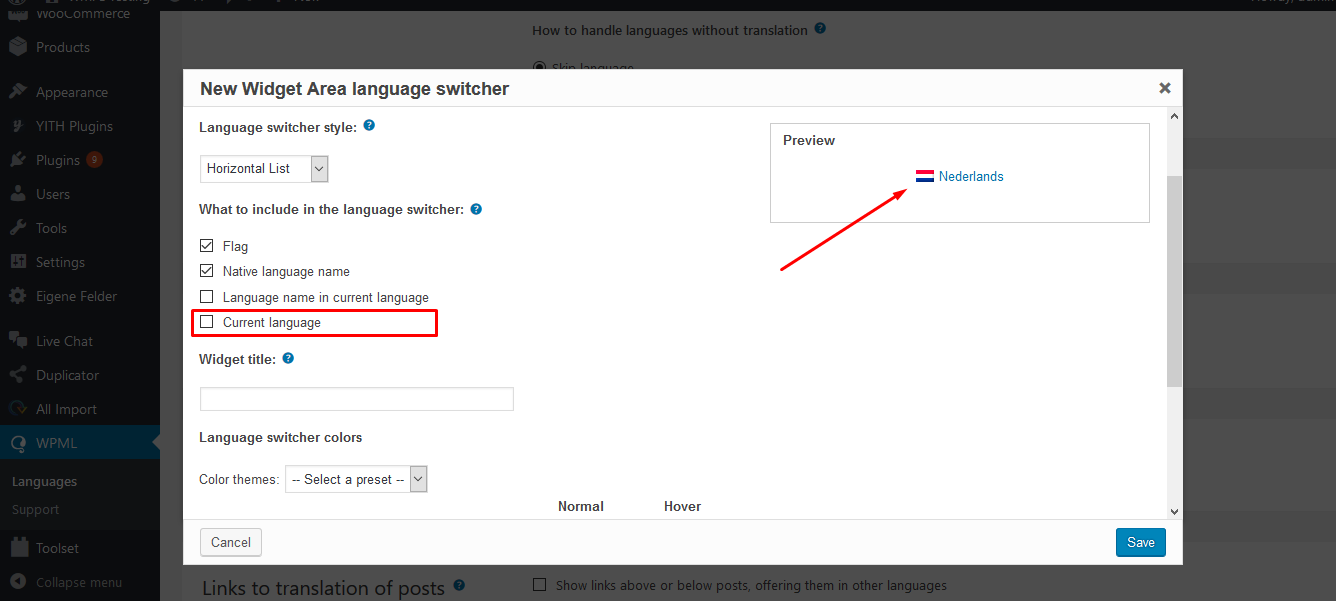
Problem: The client reported that the language switcher was not working on the desktop version of their site when viewed in English, although it was functioning correctly in French. The mobile menu was unaffected. The site is using the Impreza theme, and the issue persisted even after the theme was updated to address a WPML compatibility issue.
Solution: We recommended the following steps: 1. Increase the WP Memory Limit to at least 128MB, preferably 256MB, by adding the following code to the
2. Clear all caches from any caching plugins and server/CDN. 3. Remove and re-add the Menu Language Switcher in WPML > Languages. 4. If the issue persists, test for a compatibility issue by deactivating all non-WPML plugins and switching to a default WordPress theme. 5. If necessary, provide access for further investigation and duplication of the site in a local testing environment.
After thorough investigation, we discovered that the desktop menu ("Menu principal") was missing a "CUSTOM LINK" for the French language, which was present in the mobile menu ("Menu mobile"). We added the missing custom link to the desktop menu, and the language switcher now appears correctly on the site.
If you're experiencing a similar issue, we recommend you try the steps outlined above. However, please note that the solution might be irrelevant due to being outdated or not applicable to your case. If the problem persists, we highly recommend checking related known issues, verifying the version of the permanent fix, and confirming that you have installed the latest versions of themes and plugins. Should you need further assistance, please open a new support ticket.
This page includes support tickets that are resolved and documented. Looking for tickets that are “in progress”? Visit the complete support tickets archive